
Last Updated: January 2026
Key Takeaways
- Starting a food truck costs $50,000–$200,000 all-in — the truck itself ($30,000–$175,000 depending on new vs. used), kitchen equipment ($10,000–$50,000), permits and licenses ($1,500–$28,000 depending on city), insurance, initial inventory, and working capital.
- Equipment financing is the most accessible option for the truck itself — the vehicle serves as its own collateral, 100% financing is available for strong borrowers, and rates run 6–15% for established businesses. Startups face higher rates but can still qualify.
- SBA Microloans (up to $50,000 through community nonprofits) are the best startup-friendly option with relaxed qualification standards. For larger needs, SBA 7(a) loans offer the lowest long-term rates but require more documentation and patience.
- Food trucks typically generate healthy margins — roughly 28–30% net before loan payments. That margin is strong enough to service debt comfortably if you manage your costs and choose financing with payments that fit your revenue pattern.
- Starting a food truck is roughly 90% cheaper than opening a brick-and-mortar restaurant. The mobile format gives you lower overhead, location flexibility, and the ability to test concepts before committing to a fixed location.
Table of Contents
- The Real Startup Costs of a Food Truck
- Best Financing Options for Food Trucks
- Equipment Loans: Financing the Truck Itself
- SBA Microloans: The Startup-Friendly Path
- What Lenders Want to See in Your Business Plan
- New vs. Used Trucks: The Financial Trade-Off
- Managing Cash Flow in a Seasonal Business
- Frequently Asked Questions
The Real Startup Costs of a Food Truck
Forget the social media fantasy of buying a cheap van and turning it into a taco empire for $10,000. The reality of launching a food truck is more expensive than most people expect — though still dramatically cheaper than a restaurant.
The truck is the biggest line item. A brand-new, custom-built food truck runs $75,000–$200,000 depending on size, equipment build-out, and customization. A used truck in decent condition costs $30,000–$100,000, but factor in another $5,000–$20,000 for retrofitting, repairs, and bringing it up to health department standards. Leasing runs $2,000–$3,000/month if you want to test the concept before committing to ownership.
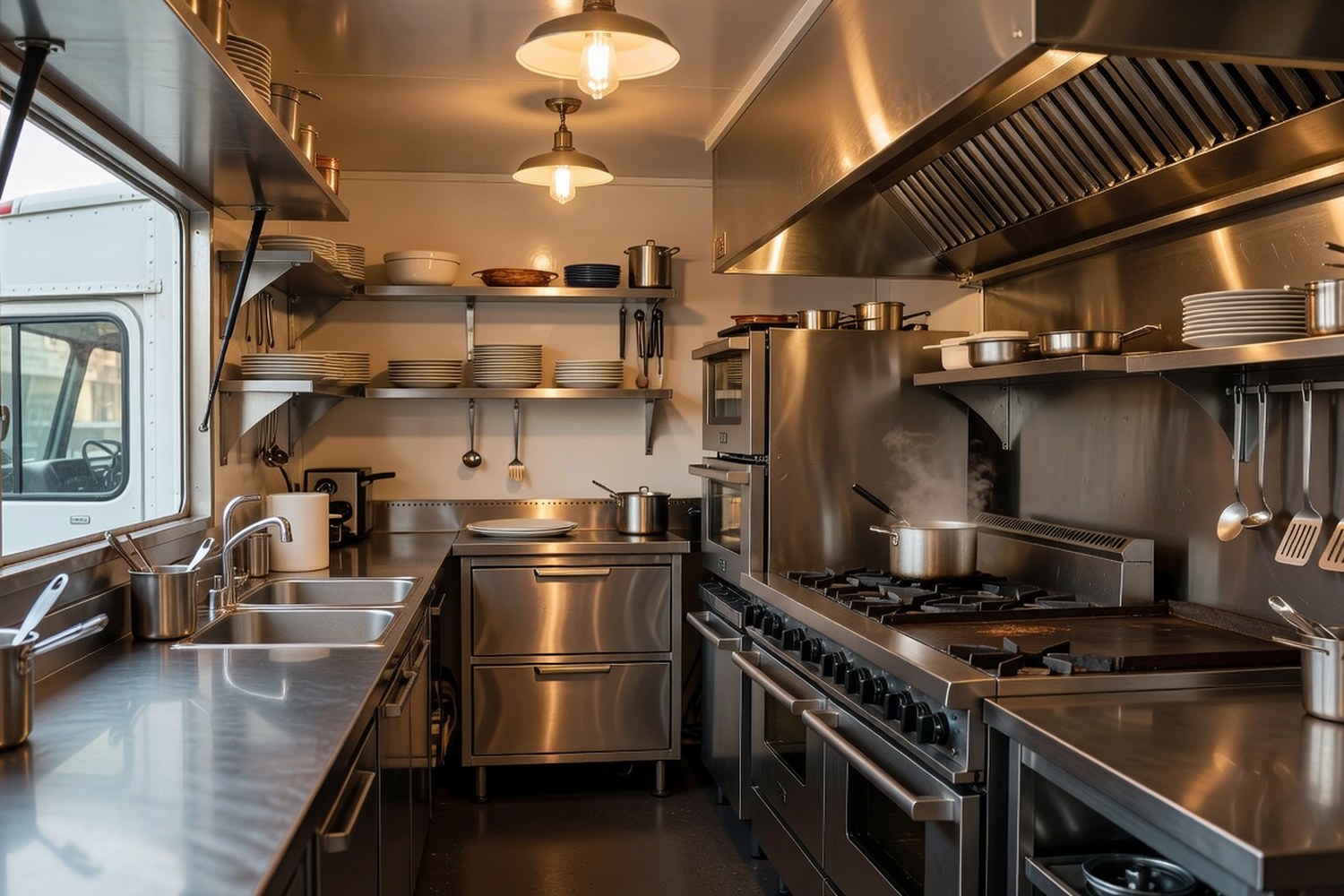
Then there is everything else. Kitchen equipment (commercial griddles, fryers, refrigeration, ventilation, fire suppression) runs $10,000–$50,000 depending on your menu complexity. Permits and licenses vary wildly by city — from $1,500 in smaller markets to $28,000+ in cities like San Francisco or New York. Health department inspections, business insurance ($300–$600/month for full coverage), commissary kitchen rental ($500–$1,500/month), initial food inventory, branding and truck wrap ($2,500–$5,000), and 2–3 months of working capital to cover expenses before revenue stabilizes.
Realistic total: $50,000–$200,000, with most full-time operators landing in the $100,000–$150,000 range. That is serious money — but still 60–80% less than the $250,000–$750,000 needed to open a brick-and-mortar restaurant, according to SBA business planning resources.
Best Financing Options for Food Trucks
| Financing Type | Typical Rates | Amounts | Terms | Best For |
|---|---|---|---|---|
| Equipment Financing | 6–15% | Up to 100% of truck value | 3–7 yr | Buying the truck itself (vehicle is collateral) |
| SBA Microloan | 8–13% | Up to $50K | Up to 7 yr | Startups needing equipment, inventory, or working capital |
| SBA 7(a) Loan | 9.75–13.25% | Up to $5M | 7–25 yr | Established trucks expanding fleet or buying real estate |
| Business Line of Credit | 8–24% | $10K–$250K | Revolving | Cash flow gaps, seasonal inventory, event prep costs |
| Business Term Loan | 8–30% | $5K–$500K | 1–5 yr | General expansion, second truck, prep kitchen buildout |
| Personal Loan | 6–36% | $1K–$100K | 2–7 yr | Startups without business credit (use personal creditworthiness) |
Rates are approximate ranges for qualified borrowers as of January 2026. Actual rates depend on credit, time in business, and lender.
Equipment Loans: Financing the Truck Itself
Equipment financing is the most natural fit for a food truck purchase. The structure mirrors a car loan: the lender finances 80–100% of the truck value, the truck serves as collateral, and you repay over 3–7 years with fixed monthly payments. If you default, the lender repossesses the truck — no other assets are at risk.
For established food truck operators (2+ years in business, 650+ credit), rates run 6–12% and many lenders offer 100% financing with no down payment. Startups face tighter terms — expect 10–20% down, rates of 12–18%, and possibly a personal guarantee. Some lenders restrict equipment financing for food trucks specifically (they categorize them differently than standard vehicles), so confirm the lender handles mobile food vehicles before applying.
What qualifies as “equipment”: Not just the truck itself. Commercial cooking equipment (griddles, fryers, ovens), refrigeration units, point-of-sale systems, generators, and food service equipment can all be financed under equipment loans. You can often bundle the truck and its kitchen build-out into a single equipment loan, simplifying the process.
The tax angle: under Section 179, you can deduct the full purchase price of qualifying equipment (including the truck) in the year of purchase. On an $80,000 used truck at a 25% tax bracket, that is a $20,000 tax savings. Consult your CPA — the deduction can dramatically reduce the effective cost of financing.
Get the truck inspected by an independent mechanic BEFORE finalizing equipment financing on a used vehicle. A $300 inspection can reveal $10,000–$20,000 in hidden problems — engine issues, frame rust, electrical problems, failed plumbing — that would blow up your budget and your loan payments. Some lenders require an inspection anyway, but do it for yourself even if they do not.
SBA Microloans: The Startup-Friendly Path
SBA Microloans are specifically designed for small businesses and startups that need $50,000 or less. The average microloan is about $13,000 — perfect for covering equipment, inventory, permits, and initial working capital for a food truck launch.
What makes microloans special for food truck startups: they are administered by nonprofit community lenders (not banks) who have more flexibility in their approval criteria. You do not necessarily need 2 years in business or a 680 credit score. The intermediary evaluates your business plan, industry experience, and personal financial situation holistically. If you have restaurant or food service experience, that counts heavily in your favor even without food truck operating history.
Rates range from 8–13% with terms up to 7 years. The application process is less intimidating than a bank loan — many intermediaries provide free technical assistance and business counseling alongside the loan. The catch: the $50,000 maximum means a microloan alone will not cover a new custom truck. It works best for used truck purchases ($30,000–$50,000), equipment upgrades, or supplementing other financing.
For larger needs, SBA 7(a) loans (up to $5 million) offer the lowest long-term rates but require more extensive documentation and longer approval timelines (4–12 weeks).

What Lenders Want to See in Your Business Plan
Every food truck lender — from equipment financing companies to SBA intermediaries — wants to see a business plan. Here is what separates plans that get funded from plans that get filed in the trash:
Concept and market validation. What do you serve, who eats it, and how do you know they want it? Catering test events, farmers market sales data, pop-up results, or social media following all count as validation. “I make great tacos” is a concept. “I have 3,000 Instagram followers, sold out at 12 events last year, and have $8,000 in catering bookings for Q2” is validation.
Financial projections with realistic assumptions. Show monthly revenue projections for Year 1 based on: average tickets per service ($8–15), number of services per week (4–6), average customers per service (50–150), plus catering and event income. A food truck serving 100 customers at $12 average ticket, 5 days a week, generates $6,000/week or $312,000/year. After food costs (28–32%), labor, fuel, insurance, permits, and loan payments, net margins of 15–25% are achievable.
Competitive landscape. Who else is in your market? What do they charge? Where do they park? How is your concept differentiated? Lenders fund businesses that understand their competition, not ones that pretend it does not exist.
Personal experience. Food service background matters enormously. Former line cooks, restaurant managers, catering company employees, or culinary school graduates get funded at higher rates than complete industry newcomers. If you lack direct experience, consider working in a food truck for 3–6 months before launching your own.
New vs. Used Trucks: The Financial Trade-Off
New custom truck ($75,000–$200,000): Built to your exact specifications. Everything is under warranty. Health department compliance is built in from day one. The downside: massive upfront cost, 3–6 month build time, and depreciation hits hard the moment it rolls off the lot. Monthly payment on a $150,000 truck at 8% over 5 years: approximately $3,040.
Used truck ($30,000–$100,000): Much lower entry cost. Faster to get on the road (days vs. months). The downside: potential hidden mechanical and kitchen equipment issues, shorter remaining useful life, and possible need for $5,000–$20,000 in upgrades to meet current health codes. Monthly payment on a $60,000 used truck at 10% over 4 years: approximately $1,522.
The smart play for startups: Buy a solid used truck ($40,000–$70,000), budget $10,000–$15,000 for upgrades, and prove the concept for 12–18 months. If the business works, upgrade to a new custom truck using the operating history and revenue track record to qualify for better financing terms. If it does not work, you have lost far less than you would have on a $175,000 custom build.
When buying used, check the generator hours (not just truck mileage). A food truck generator runs constantly during service and is one of the most expensive components to replace ($3,000–$8,000). A truck with low road mileage but 5,000+ generator hours may need a generator replacement within months of purchase — a cost that should be factored into your offer price or financing plan.
Managing Cash Flow in a Seasonal Business
Food trucks are seasonal businesses in most markets. Summer revenue can be 2–3x winter revenue, and your financing needs to accommodate that reality. Here is how experienced operators structure their finances:
Build a 3-month cash reserve during peak season. When revenue is strong (May–September in most markets), set aside 15–20% of gross revenue into a reserve account. This fund covers loan payments, insurance, and fixed costs during the slow winter months without needing to draw on a credit line.
Use a business line of credit as a seasonal bridge. Draw on the line during January–March when revenue is lowest, repay aggressively during the summer peak. You only pay interest on what you draw, making it cheaper than carrying a term loan balance through slow months. Rates of 10–18% on a drawn balance of $10,000–$20,000 for 3 months cost $250–$900 — far less than missing a $3,000 equipment loan payment.
Diversify revenue streams to flatten the curve. Catering, private events, corporate lunch programs, and festival bookings can fill winter gaps. Some operators rent their trucks to other cooks during off-seasons. Others shift to indoor pop-up locations or ghost kitchen arrangements. The more consistent your year-round revenue, the better your financing options and the easier your cash flow management. Compare lending options on our business loans page.
Frequently Asked Questions
How much does it cost to start a food truck?
Total startup costs range from $50,000 to $200,000, with most full-time operators landing in the $100,000–$150,000 range. This includes the truck ($30,000–$200,000), kitchen equipment ($10,000–$50,000), permits ($1,500–$28,000), insurance, initial inventory, and working capital. Starting a food truck is roughly 60–80% cheaper than opening a restaurant.
Can I get a loan for a food truck with no experience?
It is harder but possible. SBA Microloans through community intermediaries are the most accessible option for newcomers. Equipment financing (where the truck is collateral) is also available with 10–20% down. Having a strong business plan, some food service background, and pre-validation (event sales, social media following) significantly improves your odds. A personal loan is another backup option using your personal credit.
What credit score do I need for food truck financing?
Equipment financing: 600+ (some lenders accept lower with higher down payments). SBA Microloans: flexible, evaluated holistically. SBA 7(a): 680+. Online business lenders: 580+. Business line of credit: 650+. Better credit unlocks lower rates and 100% financing.
Should I buy a new or used food truck?
For first-time operators: buy used ($30,000–$70,000) and budget $10,000–$15,000 for upgrades. Prove the concept for 12–18 months before investing in a custom build. For established operators expanding: a new custom truck ($75,000–$200,000) built to your specifications makes sense when you have revenue history and qualify for better financing terms.
How long does food truck financing take?
Equipment financing: 1–7 days for approval, funding within a week. SBA Microloans: 2–6 weeks. SBA 7(a): 4–12 weeks. Online business lenders: 1–3 days. Personal loans: same day to 1 week. Plan your financing timeline 60–90 days before you need the truck to avoid delays.