
- Finishing a basement costs $18,000-$35,000 on average, while a full remodel with layout changes runs $25,000-$75,000+ — that’s a project most homeowners can’t fund from savings alone
- Personal loans are the fastest, safest financing option for basement projects under $50K: no collateral required, 1-3 day funding, and fixed rates from 6-36% depending on credit — LightStream, SoFi, and Upgrade lead the pack
- A HELOC makes sense for basements over $30K if you’ve got 20%+ equity — the lower rate (7-9%) saves enough to offset closing costs at that project size, but your home is collateral
- Finished basements return 70-80% of costs at resale according to the National Association of Realtors — one of the strongest ROI home improvement projects, making financing a defensible investment
- Budget 20-25% over your contractor quote for basement-specific surprises: moisture issues, foundation cracks, low headroom fixes, and radon mitigation that surface once walls come down
What Basement Remodels Actually Cost
Basements are deceptive. The space is already there — walls, floor, ceiling — so it feels like the hard part is done. Then you start pricing out the work and realize that converting a concrete box into a livable room involves plumbing, electrical, HVAC extension, framing, insulation, vapor barriers, egress windows, drywall, flooring, and finishing. That “cheap” extra space gets expensive fast.
The cost breakdown depends entirely on what you’re starting with and what you want to end up with. Basement finishing — taking an unfinished space with concrete walls and exposed joists and converting it to a basic livable area with walls, ceiling, lighting, flooring, and maybe a half bath — runs $18,000-$35,000 for a standard 1,000 sq ft basement. That’s roughly $18-$35 per square foot. A basement remodel — where you’re making structural changes, moving walls, adding a full bathroom, building a wet bar or kitchenette, or creating a separate entrance for a rental unit — costs $25,000-$75,000+. And a high-end basement buildout with home theater, custom bar, bathroom with walk-in shower, and premium finishes can hit $100,000 or more.
Here’s what most people miss in their budgets. Moisture mitigation ($2,000-$8,000) — basements are below grade, and water intrusion kills projects. If your foundation has cracks, seepage, or high humidity, that gets fixed first. Radon testing and mitigation ($800-$2,500) is required or strongly recommended in most states. Egress windows ($2,500-$5,000 each) are legally required for any bedroom. And permit fees, which vary wildly by municipality but typically run $500-$2,000 for a full basement buildout. Add all of that to the contractor’s base quote, and you’re typically 20-25% over what you initially expected.
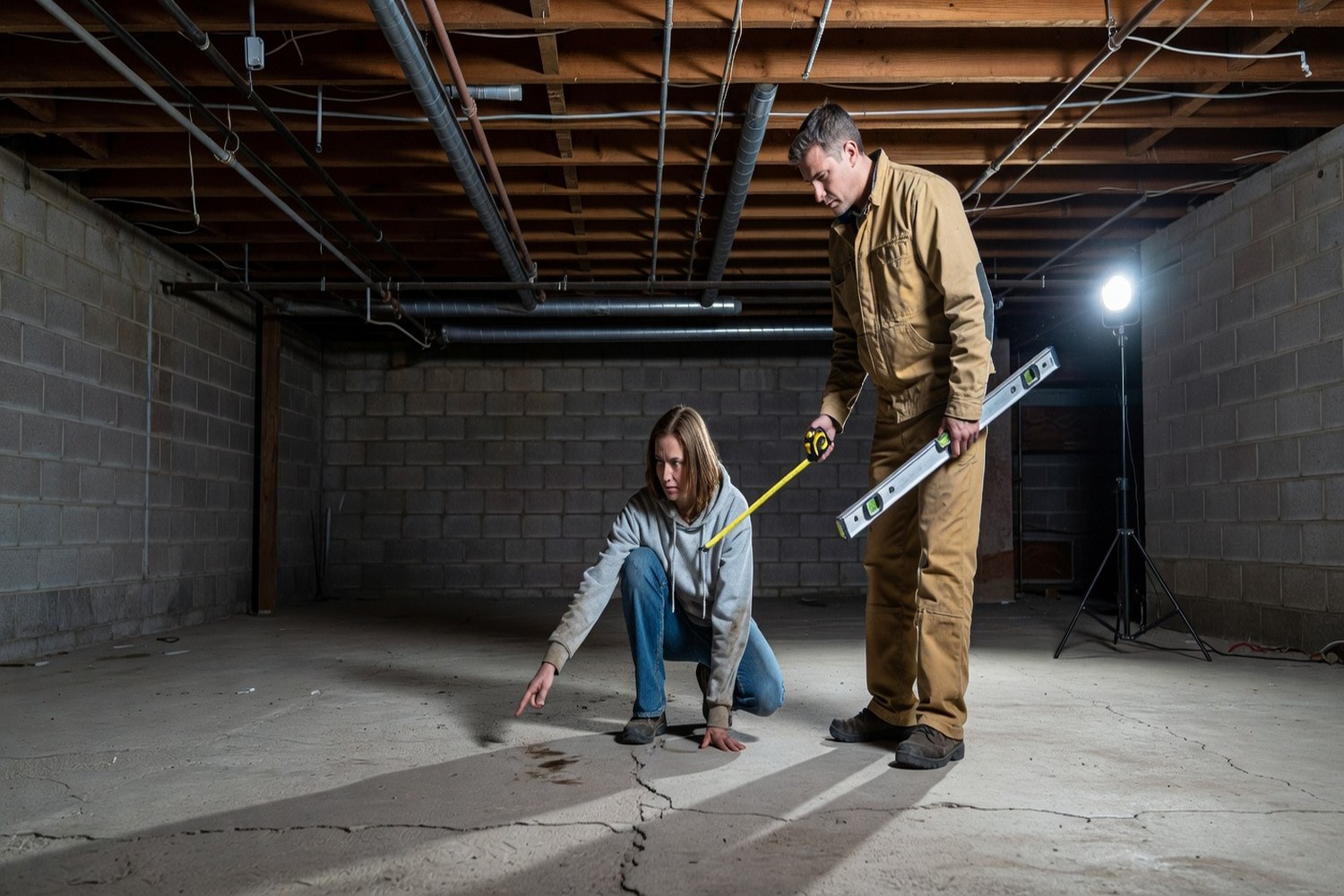
Budget 20-25% over your contractor’s quote — moisture problems, radon mitigation, and egress windows are the surprises that inflate basement projects beyond initial estimates.
Financing Options Compared
Personal loan (best for most basement projects under $50K). This is where 70% of basement financing starts — and for good reason. No collateral means your home isn’t at risk if the project goes sideways or your financial situation changes. Rates run 6-36% depending on credit, terms from 2-7 years (LightStream goes to 12), and you’ll have funds in 1-3 business days. The personal loan is especially strong for basement finishing ($18K-$35K) where the project cost falls well within typical loan maximums. For a $25,000 basement finish at 10% over 60 months: $531/month, $6,868 total interest. No closing costs, no appraisal, no home equity required.
Home equity loan (best for $30K+ remodels when you want fixed payments). If you’ve built 20%+ equity in your home, a home equity loan gives you a lump sum at 7-9% fixed. That’s materially cheaper than most personal loans. On the same $25,000 at 8% over 60 months: $507/month, $5,404 total interest — saving $1,464 versus the personal loan scenario. But closing costs of $2,000-$5,000 eat into that savings. And your home is collateral. The breakeven point where home equity loan savings offset closing costs is around $30,000 for most borrowers.
HELOC (best for phased basement projects or uncertain scope). A home equity line of credit works like a credit card backed by your home equity. Draw what you need, when you need it. This is particularly useful for basements because scope changes are common — you find moisture problems, decide to add a bathroom mid-project, or upgrade to better soundproofing between floors. Variable rates of 7-9% for strong credit, but the draw flexibility is the real advantage. The downside: variable rates can rise, and closing costs ($2,000-$5,000) apply just like home equity loans.
FHA 203(k) loan (best for recent home purchases needing basement work). If you’re buying a home that needs a basement finished, the FHA 203(k) rolls the purchase price and renovation costs into one mortgage. Down payments as low as 3.5%. This is a niche product — it doesn’t help existing homeowners who just want to remodel — but for buyers, it’s powerful. The application process is complex and slow (45-60 days), and you’ll need an FHA-approved contractor and a HUD consultant for projects over $35,000.
0% APR credit card (best for small finishing touches under $8K). If you’re doing a modest basement upgrade — adding better lighting, finishing one section, or doing the work yourself — a 0% intro APR card for 15-21 months is literally free money if paid off in time. Chase Slate Edge, Citi Simplicity, and Wells Fargo Reflect are solid options. But this only makes sense for small portions of the project. Putting $30,000 on a credit card, even at 0%, is a recipe for disaster if anything delays your payoff plan.
Lender Comparison Table
| Lender | APR Range | Loan Amount | Term | Min. Credit | Best For |
| LightStream | 6.49%-25.49% | $5K-$100K | 2-12 years | ~695 | Lowest rate, long terms |
| SoFi | 8.74%-29.99% | $5K-$100K | 2-7 years | 680 | Unemployment protection |
| Upgrade | 8.49%-35.99% | $1K-$50K | 2-7 years | 580 | Fair credit borrowers |
| LendingClub | 9.57%-35.99% | $1K-$40K | 2-5 years | 600 | Mid-credit, co-borrowers |
| Best Egg | 8.99%-35.99% | $2K-$50K | 3-5 years | 600 | Fast funding, secured option |
| HELOC (avg) | 7%-9% variable | Up to 85% LTV | 10yr draw + 20yr repay | 680 | Large projects, equity owners |
Rates reflect general ranges as of early 2026. Your actual rate depends on credit score, income, and loan amount. Always pre-qualify to see your specific rate.
Best Personal Loans for Basement Projects
Personal loans dominate basement financing for one simple reason: the typical basement project ($18K-$50K) falls squarely in the personal loan sweet spot — large enough that a credit card doesn’t make sense, but not so large that you need to tap home equity and risk your house.
LightStream is the top pick for borrowers with good credit (695+). Their home improvement loan category starts at 6.49% with autopay — the lowest fixed rate you’ll find for an unsecured loan. But LightStream’s real advantage for basement projects is the 12-year maximum term. On a $35,000 basement remodel at 7.5% over 84 months, that’s $533/month instead of $699/month on a 60-month term. Same rate, but $166/month more breathing room. Zero origination fee, zero late fees, and their Rate Beat Program guarantees they’ll match any competitor’s rate minus 0.10%. One quirk: no soft-pull pre-qualification on their site. Use Credible to check rates without a hard inquiry first.
SoFi stands out for its unemployment protection. If you lose your job during a basement project — which absolutely happens, especially when projects stretch over 3-6 months — SoFi pauses your payments for up to 12 months. Rates start at 8.74%, no origination fee, and funding can hit your account the same day you’re approved. For a $25,000 basement finish at 9% over 60 months: $519/month, $6,118 total interest.
Upgrade is the go-to for fair credit borrowers (580-699). If your credit isn’t strong enough for LightStream or SoFi, Upgrade accepts scores as low as 580 and offers multiple rate discounts — autopay, direct payment to contractors, and more. The trade-off is an origination fee (1.85-9.99%) that gets deducted from your loan proceeds. On a $25,000 basement loan with a 5% origination fee: you receive $23,750, but owe on the full $25,000. Factor that in when deciding how much to borrow.
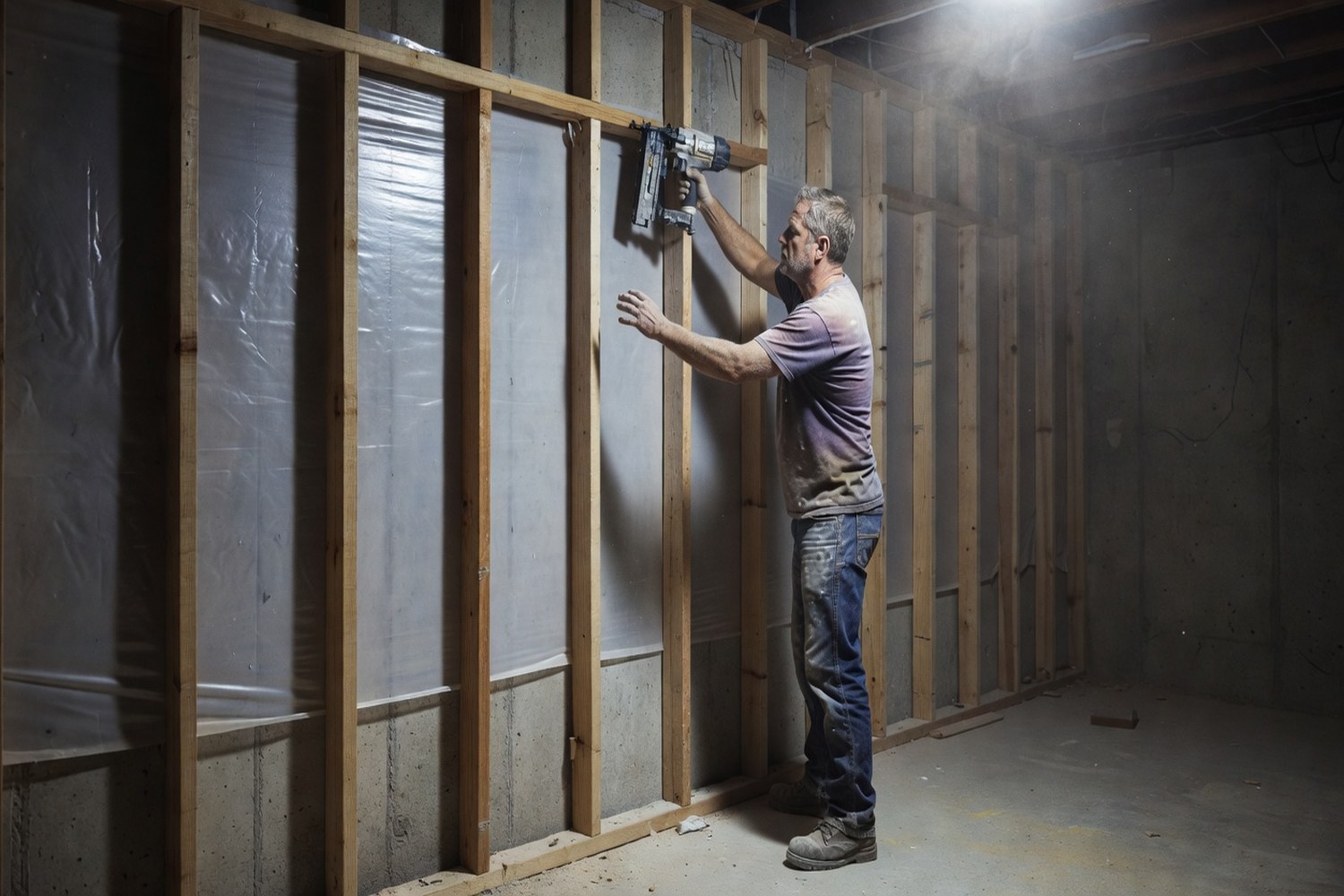
Framing, electrical, plumbing, and insulation — a basement finish involves more trades than most homeowners expect, driving costs well above initial estimates.
When a HELOC Beats a Personal Loan
The math on this is pretty straightforward once you factor in closing costs — and most advice articles skip that part.
At $20,000: Personal loan at 10% over 5 years = $5,496 total interest, $0 upfront costs. HELOC at 8% over 5 years = $4,331 total interest, $2,500 average closing costs. Net: HELOC costs $6,831 total versus personal loan at $5,496. Personal loan wins by $1,335.
At $35,000: Personal loan at 10% over 5 years = $9,618 total interest, $0 upfront. HELOC at 8% over 5 years = $7,580 total interest, $3,000 closing costs. Net: HELOC at $10,580 versus personal loan at $9,618. Still close — personal loan wins by $962.
At $50,000: Personal loan at 10% over 5 years = $13,740 total interest, $0 upfront. HELOC at 8% over 5 years = $10,829 total interest, $3,500 closing costs. Net: HELOC at $14,329 versus personal loan at $13,740. Basically even.
At $75,000: Personal loan at 10% over 5 years = $20,610 total interest. HELOC at 8% over 5 years = $16,243 total interest, $4,000 closing costs. Net: HELOC at $20,243 versus personal loan at $20,610. HELOC wins by $367 — and the gap widens from here.
The crossover point is around $50,000-$60,000 for most borrowers. Below that, the personal loan’s zero closing costs outweigh the higher rate. Above that, the HELOC’s lower rate has enough runway to overcome the upfront costs. But there’s a second factor most people ignore: a HELOC’s rate is variable. If rates rise 1.5% during your repayment period, the HELOC advantage evaporates entirely even at $75,000. The personal loan’s fixed rate provides certainty the HELOC can’t match.
Basement-Specific Mistakes That Cost Thousands
Skipping the moisture test and waterproofing. This is the single most expensive mistake in basement financing. You borrow $25,000, the contractor finishes the drywall and flooring, and six months later you have mold behind the walls because nobody tested for moisture intrusion. Now you’re tearing out $8,000-$12,000 in finished work to remediate. A $500 moisture test and $2,000-$5,000 in preventive waterproofing before any finishing work begins is non-negotiable. If your contractor doesn’t insist on it, find a different contractor.
Borrowing the contractor’s base quote with no contingency. Basements have more hidden surprises than any other room in the house. Foundation cracks appear when you strip the walls. Old plumbing doesn’t meet code. Asbestos wraps the heating ducts. The floor drain is clogged or doesn’t connect to anything. Budget 20-25% above the contractor’s quote — not the 10-15% people use for above-grade renovations. If the quote is $30,000, borrow $36,000-$37,500.
Forgetting egress window requirements. If you’re creating a bedroom in the basement (the most common use case for rental income), building codes in virtually every jurisdiction require at least one egress window per bedroom — a window large enough for a person to climb through in an emergency. Each egress window costs $2,500-$5,000 installed, including cutting through the foundation wall and installing a window well. If your basement plan includes two bedrooms, that’s $5,000-$10,000 you might not have budgeted.
Ignoring the loan term vs. project lifespan math. A basement finish has a useful life of 15-25 years before it needs significant updating. If you finance $30,000 on a 7-year term, you’ll be done paying 7 years before the space needs major work — good financial planning. If you stretch to a 12-year term or a 30-year HELOC, you might still be paying for the original basement when it’s time to renovate again. Keep the financing timeline shorter than the project’s useful life.
Step-by-Step: Finance Your Basement
Step 1: Get the moisture test done first ($300-$500). Before you call a contractor, before you sketch floor plans, before you price out financing — hire a waterproofing specialist to test your basement for moisture intrusion. A calcium chloride test, relative humidity test, or thermal imaging scan will tell you whether you need waterproofing work before any finishing begins. This one step saves you from the most expensive basement mistake.
Step 2: Get 3 contractor quotes and define your scope clearly. Walk the basement with each contractor. Get itemized quotes that separate: framing and insulation, electrical, plumbing (if adding bathroom/wet bar), HVAC extension, drywall and finishing, flooring, and egress windows. Itemized quotes let you compare apples to apples and identify where your money is actually going. Add 20-25% contingency to the highest quote — that’s your target loan amount.
Step 3: Check your credit and decide: personal loan or HELOC. Pull your credit score free through Credit Karma or your credit card issuer. Under $50K project: lean personal loan. Over $50K with equity: consider HELOC. Under 660 credit: Upgrade or Upstart (personal loan). Over 695: LightStream for the best rate.
Step 4: Pre-qualify at 2-3 lenders (soft pull, no credit impact). SoFi, Upgrade, LendingClub, and Credible (which shops LightStream) all offer soft-pull pre-qualification. Compare APR, monthly payment, origination fees, and total cost. This takes 15-20 minutes and typically saves $1,500-$4,000 on a $30K loan.
Step 5: Apply, fund, and start the project with a payment schedule. Once you pick a lender, submit the formal application. Personal loan funds typically arrive in 1-3 business days. Pay the contractor on a schedule: 10-20% deposit, 30-40% at the framing/rough-in milestone, 30-40% at the finish milestone, and 10% upon final inspection and punchlist completion. Never pay 100% upfront — the final holdback is your leverage for getting punchlist items resolved.
Frequently Asked Questions
What’s the best loan to finish a basement?
For most homeowners: a personal loan from LightStream (lowest rates starting at 6.49%) or SoFi (unemployment protection included). LightStream’s 12-year term is especially useful for larger basement projects where you want lower monthly payments. For projects over $50K with home equity available: a HELOC may offer lower total cost.
How much does it cost to finish a basement?
Basic finishing (walls, ceiling, lighting, flooring): $18,000-$35,000 for a standard 1,000 sq ft space. A full remodel with bathroom, wet bar, or layout changes: $25,000-$75,000+. High-end buildouts with home theater, custom bar, and premium finishes: $75,000-$100,000+. Always add 20-25% contingency for moisture remediation, egress windows, and code compliance surprises.
Is finishing a basement worth the investment?
The National Association of Realtors reports 70-80% return on investment for finished basements at resale. It’s one of the strongest ROI home improvement projects. Beyond resale value, a finished basement adds 500-1,500 sq ft of livable space without the cost of an addition — and if you build a legal rental unit, the rental income can offset or exceed your monthly loan payment.
Can I finance a basement with bad credit?
Yes. Upgrade accepts credit scores as low as 580. Upstart uses AI underwriting with no minimum score. Expect 15-30% APR at lower credit tiers. On $25,000 at 20% over 5 years: $662/month, $14,729 total interest. That’s expensive, but if the finished basement generates rental income of $800-$1,200/month, the numbers can still work.
Should I use a HELOC or personal loan for my basement?
Personal loan for projects under $50K — the zero closing costs outweigh the higher rate at this size. HELOC for projects over $50K if you have 20%+ equity and are comfortable with variable rate risk. The crossover point where HELOC savings offset closing costs is around $50,000-$60,000 for most borrowers.
References
- National Association of Realtors, “Remodeling Impact Report,” nar.realtor
- CFPB, “What Is a Home Equity Line of Credit?” consumerfinance.gov
- IRS, “Publication 936: Home Mortgage Interest Deduction,” irs.gov
- EPA, “Radon in Homes,” epa.gov
Keep Reading
- Best Personal Loans: Compare Rates & Apply Online
- Best Home Improvement Loans & Financing
- Best Bathroom Remodel Financing & Loan Options
- Best Kitchen Remodel Financing Options
- Best Personal Loans for Fair Credit
Rates and terms are subject to change. This is not financial advice. All information is for educational and comparison purposes only. Basement remodel cost estimates based on national averages as of early 2026. Always get multiple contractor quotes and verify current lender rates before committing to financing.