
- New flooring costs $3-$22 per square foot installed — a 1,500 sq ft home can run $4,500 for basic laminate up to $33,000+ for hardwood, making financing necessary for most full-home projects
- A personal loan is the best all-around financing choice for flooring: no collateral, fixed rates from 6-36%, 1-3 day funding, and you’re treated as a cash buyer (which means better negotiating power with retailers)
- Retailer 0% financing (Empire Today, Lumber Liquidators, Home Depot) sounds great but often uses deferred interest — miss the payoff deadline by one day and you owe all the retroactive interest, typically 25-29%
- For projects under $5,000 (single room or two), a 0% APR credit card with no deferred interest is the cheapest option — literally $0 in financing costs if paid within the promo period
- Material choice drives cost more than anything: luxury vinyl plank ($3-$7/sq ft) looks like hardwood at half the price, while solid hardwood ($8-$15/sq ft) adds the most resale value — your financing amount hinges on this decision
What New Flooring Actually Costs
Flooring is one of those projects where the per-square-foot number sounds manageable until you multiply it by the actual square footage of your house. “It’s only $8 a square foot” sounds reasonable — until you realize your 1,500 sq ft home needs $12,000 in hardwood before you’ve paid a dime for labor, underlayment, transitions, or the inevitable trim work that goes with it.
Here’s the real cost picture by material, including professional installation. Laminate runs $3-$8 per square foot installed — the budget option that looks decent and holds up well in low-traffic areas. Luxury vinyl plank (LVP) is $4-$10 per square foot installed — currently the most popular flooring choice because it’s waterproof, durable, and mimics hardwood convincingly at half the cost. Engineered hardwood comes in at $6-$14 per square foot installed — real wood on top, plywood underneath, and handles humidity better than solid hardwood. Solid hardwood sits at $8-$22 per square foot installed — the premium choice that adds the most resale value but is susceptible to moisture and requires acclimation before installation. Tile (porcelain or ceramic) runs $7-$15 per square foot installed — the go-to for bathrooms, kitchens, and entryways.
For a 1,500 sq ft home, that translates to: $4,500-$12,000 for laminate, $6,000-$15,000 for LVP, $9,000-$21,000 for engineered hardwood, and $12,000-$33,000 for solid hardwood. Add 10% for waste (cuts, mistakes, replacement planks you’ll want to keep on hand), plus $500-$1,500 for old floor removal and disposal if you’re not doing it yourself. The final number is almost always higher than the material cost calculator on the retailer’s website suggests — because those calculators rarely include demolition, subfloor repair, transitions, quarter round trim, or the furniture moving you’ll inevitably pay someone to do.
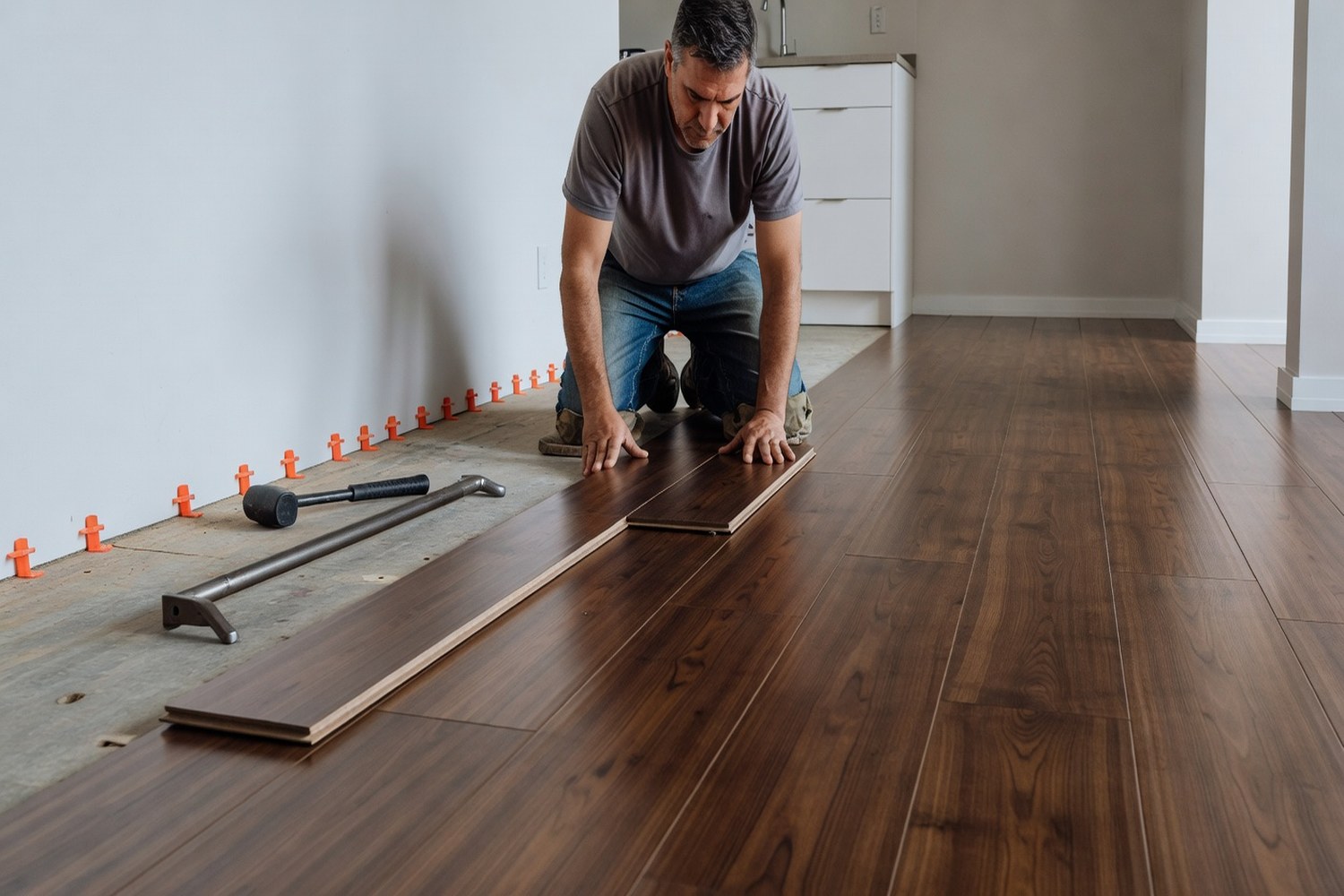
Luxury vinyl plank is the sweet spot for most homeowners — it looks like hardwood, handles water, and costs roughly half as much to install.
Financing Options Ranked
1. 0% APR credit card (best for single-room projects under $5K). If your flooring project is one or two rooms — a kitchen, a living room, an entryway — and the total is under $5,000, a 0% intro APR credit card is free money. Chase Slate Edge, Citi Simplicity, and Wells Fargo Reflect offer 15-21 months at 0%. Pay it off before the promo ends: total financing cost is $0. Unlike retailer 0% financing, these cards don’t have deferred interest — when the promo ends, interest only applies to the remaining balance going forward, not retroactively. That’s an important distinction.
2. Personal loan (best for $5K-$50K, most full-home projects). The workhorse of flooring financing. No collateral, fixed rates (6-36% depending on credit), terms from 2-12 years, and funds in 1-3 business days. The underrated advantage: with a personal loan, you show up to the flooring retailer as a cash buyer. That means you can negotiate the same cash discounts that people paying out of pocket get — whereas retailer financing often locks you into the sticker price because the retailer is paying a fee to the financing company. On a $15,000 whole-home LVP project at 10% over 60 months: $319/month, $4,121 total interest.
3. Home equity loan or HELOC (best for $20K+ premium flooring projects). If you’re installing solid hardwood throughout a large home ($25,000+), a home equity loan at 7-9% fixed beats a personal loan on total interest — but only after closing costs ($2,000-$5,000) are factored in. For flooring projects under $20,000, the personal loan wins because there are zero upfront costs. A HELOC adds flexibility if you’re doing a phased installation (room by room over several months) since you only draw what you need.
4. Retailer financing (use with extreme caution). Empire Today, Lumber Liquidators, Floor & Decor, and national chains all offer in-store financing, typically through GreenSky, Synchrony, or Wells Fargo. The headline is usually “0% for 12 months” or “no payments for 18 months.” The reality: most of these are deferred interest plans. If you don’t pay the full balance by the deadline, the lender charges all accrued interest retroactively from day one — at 25-29% APR. On a $10,000 flooring purchase with deferred interest at 26.99% for 12 months: if you miss the deadline, you owe $2,699 in surprise interest. A personal loan at 10% for the same period costs $549 in interest. The retailer financing is 5x more expensive if anything goes wrong.
5. Store credit card (worst option for most people). Home Depot, Lowe’s, and others offer store credit cards with promotional financing. Standard APR after the promo: 25-29%. Credit limits are often too low for whole-home projects. And these cards hurt your credit utilization ratio, which can lower your credit score. The only scenario where a store card makes sense: you need $3,000-$5,000, you’ll pay it off in 6 months, and the card offers 0% with no deferred interest (rare).
Lender Comparison Table
| Lender | APR Range | Loan Amount | Term | Min. Credit | Best For |
| LightStream | 6.49%-25.49% | $5K-$100K | 2-12 years | ~695 | Lowest rate, no fees |
| SoFi | 8.74%-29.99% | $5K-$100K | 2-7 years | 680 | Unemployment protection |
| Upgrade | 8.49%-35.99% | $1K-$50K | 2-7 years | 580 | Fair/bad credit |
| Best Egg | 8.99%-35.99% | $2K-$50K | 3-5 years | 600 | Fast approval, secured option |
| Upstart | 7.80%-35.99% | $1K-$50K | 3-5 years | None | No min. credit score |
| Retailer 0% | 0% (then 25-29%) | Varies | 12-18 months | Varies | Only if paid in full on time |
Rates reflect general ranges as of early 2026. Your rate depends on credit score, income, and loan amount. Pre-qualify to see your specific rate.
Best Personal Loans for Flooring
LightStream — the clear winner for good-credit borrowers. LightStream’s home improvement category starts at 6.49% with autopay, and their 12-year maximum term makes even large hardwood projects manageable. On $20,000 of solid hardwood at 7% over 84 months: $303/month. Zero origination fee, zero late fees, same-day funding, and their Rate Beat Program guarantees they’ll beat any competitor’s rate by 0.10%. You need roughly 695+ credit to qualify. One catch: no soft-pull pre-qualification on their site — use Credible to check rates first without a hard inquiry.
SoFi — best safety net for expensive flooring projects. A whole-home hardwood installation can take 2-4 weeks, during which your house is partially torn up and your life is disrupted. SoFi’s unemployment protection means if you lose your job during or after that chaos, they’ll pause payments for up to 12 months. Rates start at 8.74%, no origination fee, and same-day funding. On $12,000 of engineered hardwood at 9% over 60 months: $249/month.
Upgrade — the realistic option for 580-699 credit. If LightStream and SoFi are out of reach, Upgrade accepts credit scores as low as 580 with multiple rate discounts. The origination fee (1.85-9.99%) is the trade-off — deducted from your loan proceeds. So if you borrow $10,000 with a 5% origination fee, you receive $9,500 but owe on $10,000. Plan accordingly: if you need $10,000 for flooring, apply for $10,500.
Retailer Financing: The Deferred Interest Trap
I need to spend a full section on this because it’s where most people get burned.
When Empire Today, Luna, Floor & Decor, or Lumber Liquidators offers “0% for 12 months,” they’re almost always offering a deferred interest plan through Synchrony, GreenSky, or Wells Fargo. Here’s what that means in plain terms: interest accrues from day one at 25-29% APR, but it’s “deferred” — meaning you won’t owe it as long as you pay the entire balance before the promotional period ends. If you pay it all off in time, the deferred interest is forgiven. If you don’t — even if you’re $1 short or one day late — the full retroactive interest hits your account.
Let’s run the math. You buy $12,000 in LVP flooring with 0% deferred interest for 12 months at 26.99% APR. If you pay it off in 12 months: $0 interest, $1,000/month payments. If you miss the deadline by one day: $3,239 in retroactive interest added to your balance. Now you owe $3,239 at 26.99% going forward — and the monthly minimum payment barely covers the interest, so it takes years to dig out.
Compare that to a personal loan at 10% for the same $12,000 over 12 months: $1,056/month, $668 total interest. Yes, you pay $668 in interest — but there’s no cliff, no retroactive penalty, no $3,239 surprise. The personal loan is the “boring” option that saves you thousands if anything goes sideways.
When retailer financing actually works: if you can comfortably pay the full balance 2-3 months before the deadline (not at the deadline — buffer for surprises), and if the promotional period is 18+ months, and if you set up automatic payments from day one. Some retailers also offer true 0% installment plans (not deferred interest) where you pay fixed monthly amounts with no retroactive penalty. These are genuinely good deals — but they’re rarer. Always ask: “Is this deferred interest or a true 0% installment plan?” If the salesperson can’t answer clearly, assume it’s deferred.
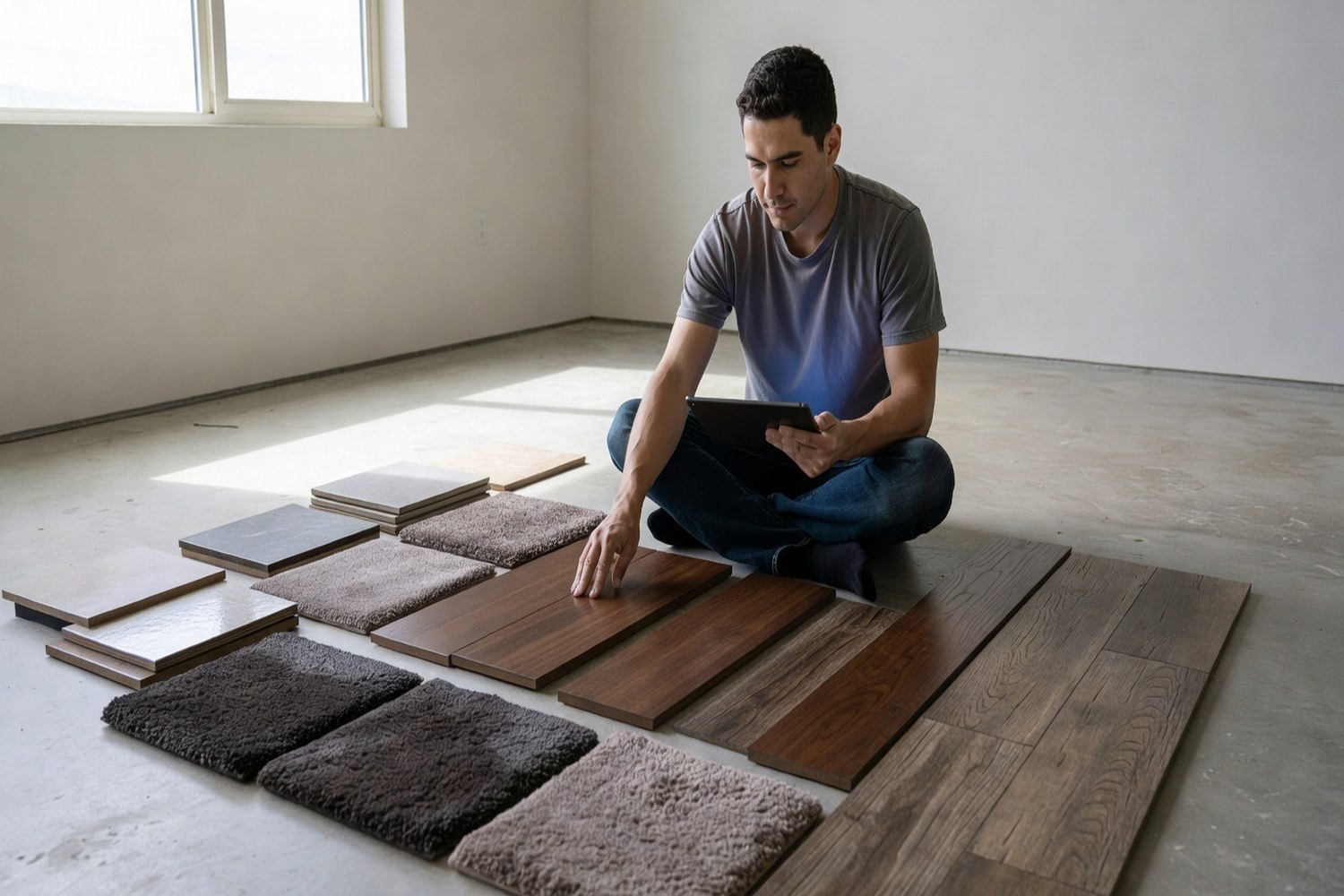
Choosing the right material is half the battle — luxury vinyl plank offers the best balance of durability, appearance, and cost for most budgets.
Flooring Loans by Credit Score
740+ (excellent credit): You’re in LightStream territory. Expect 6.49-9% APR for home improvement loans. On $15,000 over 60 months at 7%: $297/month, $2,834 total interest. This is roughly what you’d pay with a HELOC — but without risking your home or paying closing costs. At this credit tier, a personal loan is almost always the best move for flooring.
680-739 (good credit): SoFi (8.74%+) and LendingClub (9.57%+) are your primary options. On $15,000 over 60 months at 10%: $319/month, $4,121 total interest. Still very manageable. SoFi’s unemployment protection adds genuine value at this price point.
620-679 (fair credit): Upgrade and Best Egg are the strongest options here. Expect 14-20% APR. On $10,000 over 48 months at 16%: $283/month, $3,587 total interest. The origination fee on Upgrade (1.85-9.99%) adds to the cost, but it’s still far cheaper than retailer deferred interest or credit card rates.
Below 620 (bad credit): Upstart (no minimum score) and Upgrade (580+) will consider you, but rates will be 20-35%. On $8,000 over 36 months at 25%: $320/month, $3,518 total interest. At these rates, consider whether a smaller project (one or two rooms) at a lower loan amount makes more sense. Or — if your flooring can wait 6-12 months — improving your credit score from 580 to 660 could drop your rate by 8-12%, saving $2,000-$4,000 on a $10,000 loan.
How to Finance Your Flooring Project
Step 1: Decide on your material and get 2-3 quotes. Visit two or three retailers (Home Depot, a local flooring shop, and one national chain like Empire or Floor & Decor). Get itemized quotes that separate material cost per square foot, underlayment, installation labor, demolition/removal of old flooring, transitions and trim, and furniture moving. The spread between the cheapest and most expensive quote is often 25-40% — comparison shopping alone saves hundreds to thousands.
Step 2: Add 10% for waste and miscellaneous. Flooring installations always require more material than the raw square footage suggests. Cuts, pattern matching, damaged planks, and keeping a box of extras for future repairs all add up. Your loan amount = total quote + 10%.
Step 3: Check your credit and pre-qualify at 2-3 lenders. Pull your credit score free through Credit Karma. 720+: start with LightStream (via Credible). 680-719: SoFi and LendingClub. 620-679: Upgrade and Best Egg. Below 620: Upstart and Upgrade. Pre-qualification is a soft pull — no impact to your score — and takes 5-10 minutes per lender.
Step 4: Compare the personal loan to retailer financing. Before accepting the retailer’s in-store financing, compare: your personal loan APR and total cost vs. the retailer’s offer. Ask the retailer specifically: “Is this deferred interest or a true 0% installment plan?” If deferred, calculate the worst-case cost (full retroactive interest) and compare it to your personal loan. The personal loan almost always wins unless you’re certain you’ll pay off the deferred balance with months to spare.
Step 5: Fund and negotiate. If going the personal loan route, complete the application (1-3 days for funds). Then approach the retailer as a cash buyer. Ask for cash pricing, which is often 5-10% below the financed price. Schedule installation. Pay the retailer directly from your bank account after the loan deposits.
Frequently Asked Questions
What’s the best way to finance new flooring?
A personal loan from LightStream (6.49%+ for good credit) or SoFi (8.74%+) for projects $5K-$50K. For single-room projects under $5K: a 0% APR credit card. Retailer financing can work if it’s a true 0% installment plan — avoid deferred interest unless you’re absolutely certain you’ll pay off the balance early.
How much does new flooring cost for a whole house?
For a 1,500 sq ft home (installed): $4,500-$12,000 for laminate, $6,000-$15,000 for luxury vinyl plank, $9,000-$21,000 for engineered hardwood, $12,000-$33,000 for solid hardwood. Add 10% for waste and materials, plus $500-$1,500 for old floor removal.
Can I get flooring financing with bad credit?
Yes. Upgrade accepts 580+ credit scores. Upstart has no minimum score requirement and uses AI underwriting. Expect 20-35% APR at lower credit tiers. On $8,000 at 25% over 36 months: $320/month. Consider doing a smaller project or improving your credit first to get a better rate.
Is retailer 0% financing really free?
Not always. Most retailer “0%” offers use deferred interest — interest accrues at 25-29% from day one but is forgiven only if you pay the full balance by the deadline. Miss it by a day and you owe all the retroactive interest. True 0% installment plans (no retroactive penalty) are genuinely free but less common. Always ask which type you’re getting.
Should I use a home equity loan for flooring?
Only if your project exceeds $20,000 and you have 20%+ equity. Below that, closing costs ($2,000-$5,000) eat the rate savings. A personal loan with zero upfront costs is almost always cheaper for flooring projects under $20K.
References
- CFPB, “What You Need to Know About Deferred Interest,” consumerfinance.gov
- FTC, “Shopping for a Credit Card,” ftc.gov
- Federal Reserve, “Consumer Credit G.19,” federalreserve.gov
Keep Reading
- Best Personal Loans: Compare Rates & Apply Online
- Best Home Improvement Loans & Financing
- Best Kitchen Remodel Financing Options
- Best Bathroom Remodel Financing & Loan Options
- Best Personal Loans for Bad Credit
Rates and terms are subject to change. This is not financial advice. All information is for educational and comparison purposes only. Flooring cost estimates based on national averages as of early 2026. Always get multiple quotes and verify current lender rates before committing to financing.