
- A full roof replacement averages $9,500 but ranges from $5,800 to $45,000+ depending on materials, roof size, pitch, and your location — this is not a project most homeowners can fund from savings
- Personal loans are the fastest financing option for roofs: no collateral, 1-3 day funding, fixed rates from 6-36% — and unlike a HELOC, you won’t lose your house if something goes wrong financially
- Before financing anything, file a homeowners insurance claim if the damage is from a covered event (storm, hail, fallen tree) — insurance may cover part or all of the replacement minus your deductible
- Contractor financing through GreenSky or Synchrony often uses deferred interest at 25-29% — miss the payoff deadline by one day and you owe all retroactive interest from the original purchase date
- A failing roof compounds damage fast: every month you delay costs an estimated $500-$2,000 in interior water damage, mold remediation, and structural repair — financing and fixing now is almost always cheaper than waiting
What Roof Replacements Actually Cost
Nobody budgets for a new roof. It’s the kind of expense that shows up uninvited — a leak after a storm, an inspector’s report killing your home sale, or shingles curling so badly the neighbors start asking questions. And when it arrives, the numbers are brutal.
The national average for a full roof replacement sits around $9,500, but that number is misleading because it hides an enormous range. A basic 3-tab asphalt shingle roof on a simple ranch-style home runs $5,800-$9,000. Architectural shingles (the standard upgrade that most contractors now recommend) cost $8,000-$15,000. Metal roofing — standing seam or corrugated — jumps to $15,000-$30,000 but lasts 40-70 years versus 20-30 for asphalt. Slate or tile hits $25,000-$45,000+ and is essentially a forever roof, but only if your structure can support the weight.
What drives the price beyond materials: roof size (measured in “squares” — each square is 100 sq ft, and most homes have 15-25 squares), roof pitch (steeper = more expensive because it requires more safety equipment and slower work), number of layers to tear off (if you have two layers of old shingles, removal costs double), structural repairs underneath (rotted decking, damaged rafters), and your geographic market. A $9,000 roof in rural Georgia might cost $14,000 in suburban Connecticut for identical materials and scope.
The hidden cost that catches almost everyone: decking replacement. You won’t know the condition of the plywood decking under the shingles until the old roof is torn off. Roofers charge $75-$150 per sheet of plywood to replace damaged decking, and it’s not unusual to need 10-20 sheets on an older home. That’s $750-$3,000 you didn’t see in the estimate. Always ask your roofer: “What’s the per-sheet charge for decking replacement, and how will you handle it if we find damage?” Get that number in writing before work starts.
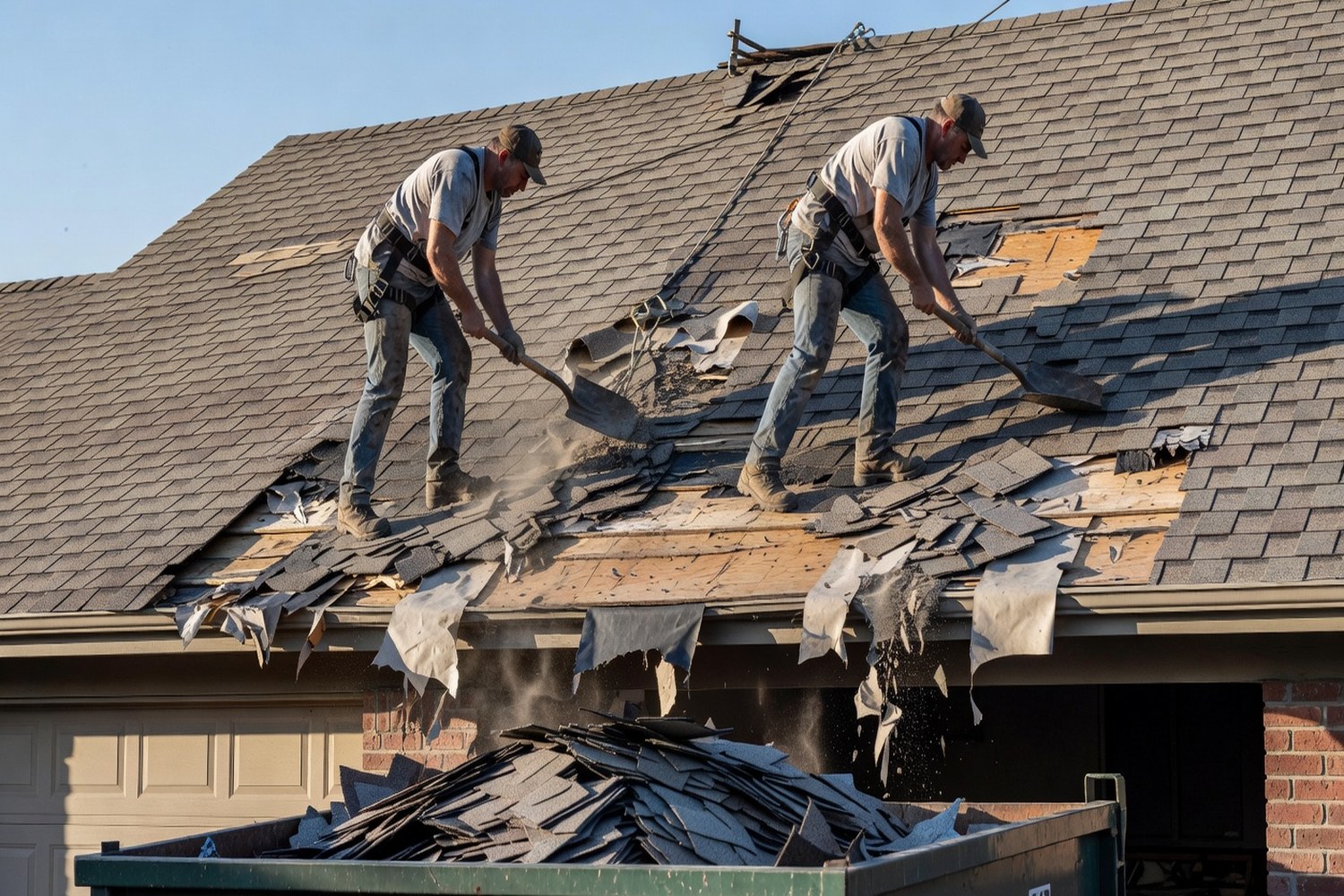
Tear-off reveals what’s underneath — damaged decking is the most common surprise cost, typically adding $750-$3,000 to your project.
Financing Options Ranked
1. Homeowners insurance (check first, always). If your roof damage is from a covered peril — hail, wind, fallen tree, fire — your homeowners insurance may cover part or all of the replacement minus your deductible ($1,000-$2,500 typical). File the claim before you finance anything. Insurance won’t cover normal wear and tear or a roof that’s simply old, but storm damage is a different story entirely. Get the adjuster out, get the determination, then figure out what you need to finance for the remainder.
2. Personal loan (best for most roof replacements). The dominant financing choice for roofs because it checks every critical box: speed (1-3 day funding for emergencies), no collateral (your house isn’t at risk), fixed rates (6-36% depending on credit), and terms long enough to keep payments manageable (2-12 years at LightStream). On a $12,000 architectural shingle roof at 10% over 60 months: $255/month, $3,297 total interest. Most online lenders let you pre-qualify with a soft pull in under 5 minutes.
3. Home equity loan (best for $15K+ premium roofing with equity). If you’ve got 20%+ equity and you’re installing metal or slate ($20,000+), a home equity loan at 7-9% fixed saves real money over a personal loan. On $20,000 at 8% over 60 months: $406/month, $4,332 total interest versus personal loan at 10%: $425/month, $5,496 total interest — saving $1,164. But closing costs ($2,000-$5,000) partially offset the savings, and it takes 2-4 weeks to close. Not ideal for emergency replacements.
4. FHA Title I loan (best for low-to-moderate income homeowners). This federally-insured program lets homeowners borrow up to $25,000 for property improvements, with loans under $7,500 unsecured. Fixed rates, terms up to 20 years. The catch: limited lender availability (not all banks participate), slower processing, and rates aren’t necessarily lower than a strong personal loan. But if you have moderate credit and limited options, it’s worth investigating through your local HUD office.
5. Contractor financing (proceed with extreme caution). Roofing companies partner with GreenSky, Synchrony, or Sunlight Financial to offer in-house financing. The pitch: “0% for 12 months” or “same as cash.” The reality: most are deferred interest plans. If you don’t pay the full balance before the promo ends, you owe all accrued interest retroactively — at 25-29% APR. On a $12,000 roof with 12-month deferred interest at 26.99%: that’s $3,239 in surprise interest if you’re even one day late. A personal loan at 10% for 12 months costs $668. Always compare before signing at the roofer’s kitchen table.
Lender Comparison Table
| Lender | APR Range | Loan Amount | Term | Min. Credit | Best For |
| LightStream | 6.49%-25.49% | $5K-$100K | 2-12 years | ~695 | Lowest rate, longest terms |
| SoFi | 8.74%-29.99% | $5K-$100K | 2-7 years | 680 | Unemployment protection |
| Upgrade | 8.49%-35.99% | $1K-$50K | 2-7 years | 580 | Fair/bad credit borrowers |
| Best Egg | 8.99%-35.99% | $2K-$50K | 3-5 years | 600 | Fast funding, secured option |
| Upstart | 7.80%-35.99% | $1K-$50K | 3-5 years | None | No minimum credit score |
| HE Loan (avg) | 7%-9% fixed | Up to 85% LTV | 5-30 years | 680 | Large projects with equity |
Rates reflect general ranges as of early 2026. Your rate depends on credit score, income, and loan amount. Pre-qualify to see your specific offer.
Best Personal Loans for Roofing
LightStream — the top pick if you have 695+ credit. Their home improvement loan category starts at 6.49% with autopay — the lowest unsecured rate available for a roof project. The 12-year maximum term is key here: a $15,000 roof at 7% over 84 months is $227/month versus $297/month on a 60-month term. Same rate, $70/month breathing room. Zero origination fee, same-day funding, and the Rate Beat Program guarantees they’ll beat any competitor by 0.10%. No soft-pull pre-qualification on their site — use Credible to check first.
SoFi — best when a roof emergency coincides with job uncertainty. A hailstorm doesn’t check your employment calendar. SoFi’s unemployment protection pauses payments for up to 12 months if you lose your job. Rates start at 8.74%, no origination fee. On a $10,000 roof repair at 9% over 48 months: $249/month, $1,944 total interest.
Upgrade — the realistic option for 580-699 credit. When LightStream and SoFi are out of reach, Upgrade gets you funded. Accepts scores as low as 580, multiple rate discounts available (autopay, direct-pay). Origination fee of 1.85-9.99% deducted from proceeds — so if you need $10,000 for the roof, apply for $10,500-$11,000 to cover the fee. On $10,000 at 16% over 48 months: $283/month, $3,587 total interest. Expensive, but still cheaper than contractor deferred interest and immeasurably cheaper than the water damage from a leaking roof.
Insurance First, Financing Second
This section could save you $5,000-$15,000, so read it carefully.
If your roof damage was caused by a storm, hail, wind, a fallen tree, or fire — file a homeowners insurance claim before you apply for any financing. This is not optional advice. Your insurance policy likely covers roof replacement for covered perils minus your deductible. Even if you think the damage is just “wear and tear,” have an adjuster look. Hail damage isn’t always visible from the ground — it takes a trained eye on the roof itself to see the bruising on shingles.
Here’s the workflow: call your insurance company, file the claim, get the adjuster’s inspection scheduled. While waiting (typically 1-2 weeks), get three contractor quotes independently. When the adjuster arrives, be present with your contractor if possible. The adjuster will assess damage and issue a determination: covered or denied, and for how much. If covered, your insurance check pays for most of the roof, and you finance only the deductible plus any upgrades beyond what insurance covers. That might turn a $12,000 financing need into a $2,500 financing need — or eliminate it entirely.
If the claim is denied or the damage isn’t from a covered event (age, wear, neglect), then you’re financing the full amount. At that point, proceed to personal loans or other options. But check insurance first. I’ve seen homeowners finance $15,000 for a roof and then realize months later that insurance would have covered $12,000 of it — but by then, the claim window had closed.
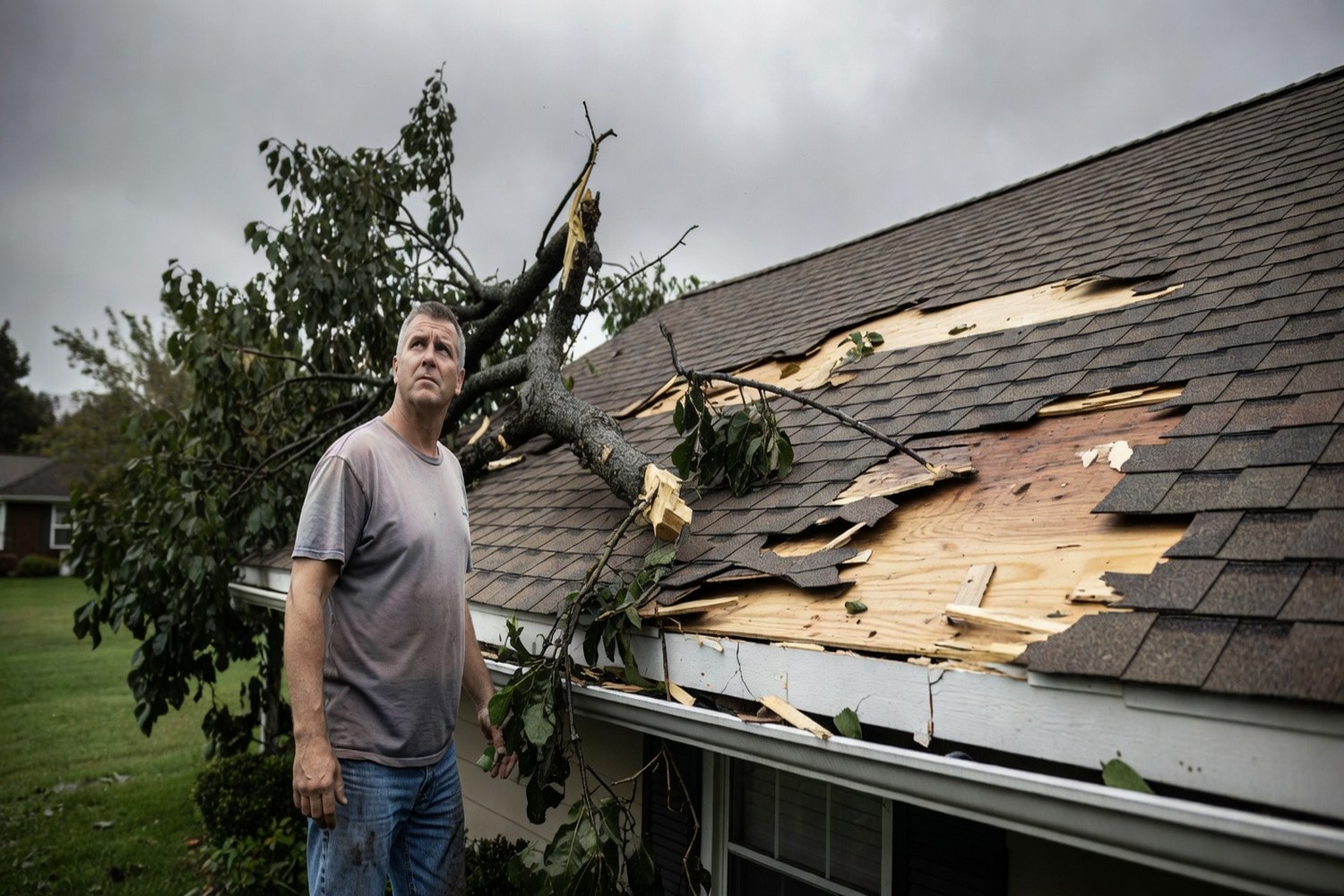
Storm damage? File your homeowners insurance claim before applying for financing — your policy may cover most or all of the replacement.
Mistakes That Cost Thousands
Waiting too long to replace a failing roof. This is the most expensive mistake homeowners make with roofing. A leaking roof doesn’t just damage shingles — it rots decking, saturates insulation, grows mold in the attic, stains ceilings, and can compromise structural framing. Every month of delay adds an estimated $500-$2,000 in secondary damage. A $10,000 roof replacement you finance today at 10% costs $12,748 total over 5 years. That same roof in 6 months — after $6,000 in water damage and mold remediation — costs $16,000 for the roof plus repairs. Financing and fixing now is almost always the cheaper path, even with interest.
Accepting contractor financing without comparison shopping. The roofer’s “0% for 12 months” sounds great over coffee at the kitchen table. But that’s usually deferred interest through GreenSky or Synchrony at 25-29% APR. Miss the payoff deadline: $3,239 in retroactive interest on a $12,000 roof. A 10% personal loan for 12 months on the same amount costs $668 total. Always pre-qualify at LightStream, SoFi, or Upgrade before the contractor visit. Walk in knowing your rate.
Choosing the cheapest quote without checking scope. The $7,500 quote doesn’t include tear-off (it’s a nail-over, which voids most manufacturer warranties). It doesn’t include ice-and-water shield in the valleys (the area most likely to leak). It uses 3-tab shingles when the two $10,000 quotes use architectural shingles (which last 10+ years longer). And it doesn’t include replacing the damaged drip edge, which means water still runs behind the fascia. The cheapest quote is usually the most expensive decision in the long run.
Skipping the decking contingency in your financing. You won’t know how much decking replacement you need until the old shingles are off. If you borrow exactly $10,000 for a $10,000 quote and the roofer finds 15 sheets of damaged decking at $100/sheet, you need $1,500 more mid-project. Scrambling for a second loan while your house has no roof is a terrible negotiating position. Borrow 15% more than the quote — on a $10,000 roof, borrow $11,500.
How to Finance Your New Roof
Step 1: File insurance if storm damage is involved. Call your carrier, file the claim, get the adjuster scheduled. This determines whether you’re financing the full cost or just the gap after insurance.
Step 2: Get 3 roofer quotes with identical scope. Specify: full tear-off (not nail-over), architectural shingles (not 3-tab), ice-and-water shield in valleys and along eaves, new drip edge and flashing, and a per-sheet price for decking replacement. Make sure all three quotes cover the same work so you’re comparing honestly.
Step 3: Add 15% contingency for decking and surprises. Your financing amount = highest quote × 1.15. If quotes average $11,000, apply for $12,650. You’d rather have a small surplus (apply it as an extra principal payment) than run short mid-project.
Step 4: Check your credit and pre-qualify. Pull your free credit score (Credit Karma). 720+: LightStream (via Credible for soft pull). 680-719: SoFi and LendingClub. 620-679: Upgrade and Best Egg. Below 620: Upstart and Upgrade. Pre-qualification takes 5-10 minutes per lender with no credit impact.
Step 5: Compare personal loan vs. contractor financing vs. HELOC. Calculate total cost for each option including interest and fees. The personal loan wins for 90%+ of roof replacements under $20,000. If going the personal loan route, complete the application, receive funds (1-3 days), then schedule the work and pay the roofer on the agreed schedule (typically 1/3 deposit, 2/3 on completion).
Frequently Asked Questions
What’s the best way to finance a new roof?
Check homeowners insurance first if the damage is storm-related. For the out-of-pocket portion, a personal loan from LightStream (6.49%+ for good credit) or SoFi (unemployment protection) is the fastest and safest option. For premium roofing over $20K with home equity: consider a home equity loan for lower rates.
How much does a new roof cost?
National average: $9,500. Basic asphalt shingles: $5,800-$9,000. Architectural shingles: $8,000-$15,000. Metal: $15,000-$30,000. Slate/tile: $25,000-$45,000+. Add 15% contingency for decking replacement and surprises found during tear-off.
Can I get a roof loan with bad credit?
Yes. Upgrade accepts 580+ credit. Upstart has no minimum score. Expect 15-30% APR at lower credit tiers. On $10,000 at 20% over 48 months: $304/month, $4,573 total interest. A failing roof is an emergency — even at higher rates, financing the repair now avoids $5,000-$10,000+ in water damage and mold costs from waiting.
Does homeowners insurance cover a new roof?
If the damage is from a covered peril (storm, hail, wind, fire, fallen tree): usually yes, minus your deductible ($1,000-$2,500). If the roof is failing due to age or neglect: usually no. Always file a claim and get an adjuster’s determination before financing — it could reduce your out-of-pocket cost by $5,000-$15,000.
Is contractor financing a good deal for roofing?
Rarely. Most roofing contractor financing uses deferred interest (25-29% APR) that charges all retroactive interest if you miss the payoff deadline. A personal loan at 10% costs far less in almost every scenario. The only exception: a true 0% installment plan with no deferred interest — ask specifically before accepting.
References
- CFPB, “What You Need to Know About Deferred Interest,” consumerfinance.gov
- HUD, “FHA Title I Property Improvement Loan Program,” hud.gov
- Federal Reserve, “Consumer Credit G.19,” federalreserve.gov
- FEMA, “After a Disaster: Insured and Underinsured,” fema.gov
Keep Reading
- Best Personal Loans: Compare Rates & Apply Online
- Best Home Improvement Loans & Financing
- Best Flooring Financing for Good & Bad Credit
- Best Personal Loans for Bad Credit
- Best Personal Loans for Fair Credit
Rates and terms are subject to change. This is not financial advice. All information is for educational and comparison purposes only. Roof replacement cost estimates based on national averages as of early 2026. Always get multiple contractor quotes and verify current lender rates before committing to financing.