
- A new boat dock costs $3,700-$30,000 for a standard residential dock and up to $50,000+ for a large custom dock with a boat lift — add a boat lift ($2,000-$15,000) and you’re financing $6,000-$65,000 total
- Personal loans are the most practical financing option: no collateral, 1-3 day funding, fixed rates from 6-36% — most banks don’t offer “dock loans” as a product category, so a personal loan or home improvement loan is how this gets financed
- Credit unions near lakes and waterways often have dedicated boat dock loan programs with rates 1-2% lower than online lenders — check your local credit union before applying with a national lender
- Permits ($200-$2,000+) are required in nearly every jurisdiction for dock construction — and in some states, the permitting process takes 3-6 months, so start the permit application before you apply for financing
- A dock is one of the few waterfront improvements that adds direct property value — lakefront homes with private docks sell for 15-25% more than comparable homes without dock access, making financing a defensible investment
What Boat Docks & Slips Actually Cost
Building a boat dock is one of those projects where the range is so wide it’s almost meaningless without context. A basic aluminum roll-in dock for a small lake cottage costs $3,000. A permanent pile-driven dock with a covered slip, boat lift, and composite decking on a coastal property costs $60,000. The difference is materials, size, water conditions, and how much infrastructure you’re building beyond the dock itself.
Here’s the realistic breakdown by dock type. A floating dock (modular polyethylene or aluminum sections, anchored by chains or cables) runs $2,000-$8,000 for a basic configuration. These are the entry-level option — easy to install, removable for winter, and no permit required in some jurisdictions. A pipe dock (aluminum frame with removable legs that sit on the lake bottom) costs $3,000-$10,000 and works well in water up to 6 feet deep with a firm bottom. A permanent pile dock (wood or composite decking on driven pilings) is $8,000-$30,000 and is the standard for serious waterfront properties — built to last 20-30 years. A crib dock (log or timber crib filled with rock, decked on top) runs $10,000-$25,000 and is common on rocky shorelines where pilings can’t be driven.
Now add the extras. A boat lift ($2,000-$15,000 depending on capacity and type — manual cradle lifts are cheapest, hydraulic lifts for heavy boats are most expensive) is almost always worth adding during dock construction because retrofitting later costs 30-50% more. Electrical service to the dock ($1,500-$4,000 for a GFI-protected circuit, dock lighting, and a boat lift outlet) is code-required in most jurisdictions if you’re running power. Permits ($200-$2,000+ depending on state and locality — more on this below). And site preparation ($500-$3,000 for shoreline grading, erosion control, and equipment access).
Total project cost for a typical residential dock with boat lift: $12,000-$35,000. For a large custom dock with covered slip, lift, and composite decking: $30,000-$65,000. That’s the number to finance — not just the dock structure itself.
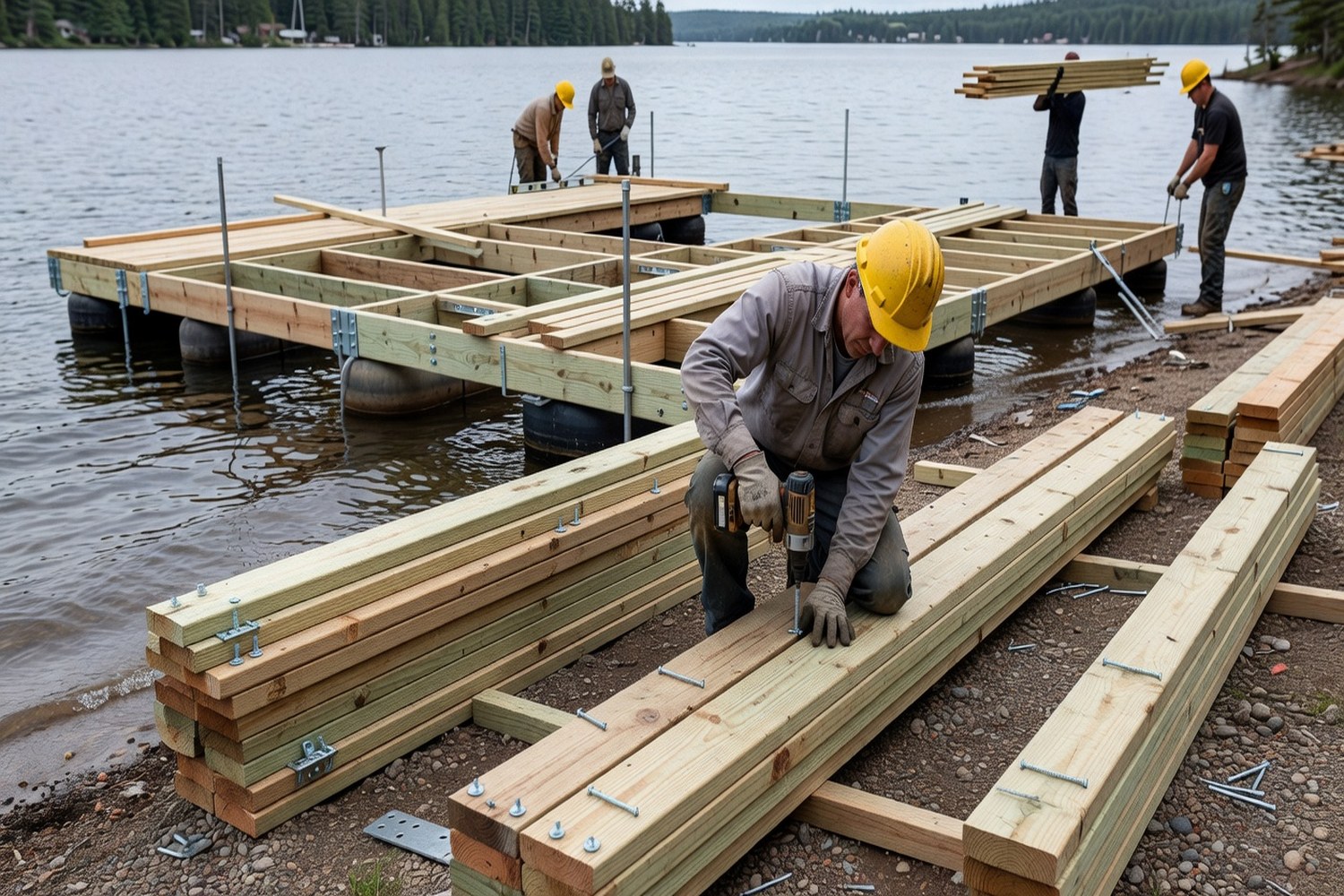
Dock construction involves marine-grade materials, permits, and often a boat lift — budget 30-50% above the basic dock quote for the full project.
Financing Options Ranked
1. Personal loan (best for most dock projects). Banks don’t have a “boat dock loan” product. What they have is personal loans and home improvement loans — and either works perfectly for dock financing. No collateral required (your dock or house isn’t at risk), fixed rates from 6-36%, funding in 1-3 days, terms up to 12 years at LightStream. On a $20,000 dock with boat lift at 8% over 60 months: $406/month, $4,332 total interest. The simplicity is the advantage: apply online, get approved, receive funds in your bank account, pay the dock builder directly.
2. Credit union dock loan (check your local CU first). Credit unions near popular lake and coastal areas often have specific boat dock and boat lift loan programs. Listerhill Credit Union in Alabama, for example, offers dedicated dock loans that include accessories like boat lifts. Credit union rates run 1-2% below online lenders for comparable credit profiles, and they understand waterfront construction. If you live near water, call your local credit union before applying anywhere else.
3. Home equity loan or HELOC (best for $25K+ dock projects with equity). If your dock project is part of a larger waterfront improvement ($25,000+ for dock, seawall, landscaping, outdoor living area), tapping home equity at 7-9% beats a personal loan on total cost. The math works at this project size because closing costs ($2,000-$5,000) are offset by the lower rate. A HELOC’s draw flexibility is especially useful for phased waterfront projects — dock this spring, seawall next fall.
4. Marine/dock contractor financing. Some dock builders partner with lenders like Acorn Finance, HFS Financial, or GreenSky. Convenience: you apply during the consultation. Risk: the rate may be 2-4% higher than a personal loan you’d get on your own. Always pre-qualify independently first, then compare. If the builder’s offer is competitive, great — if it’s 2%+ higher, use your personal loan.
5. Boat loan extension (if buying a boat and dock together). If you’re financing a boat purchase and building a dock simultaneously, some marine lenders will roll dock costs into the boat loan — securing both with the vessel. This can lower the rate on the dock portion (secured marine loans run 6.5-8.5% for good credit versus 8-12% unsecured). Ask your marine lender if they’ll include dock construction in the boat loan. Not all will, but it’s worth asking.
Lender Comparison Table
| Option | Rate | Amount | Term | Best For | Speed |
| LightStream | 6.49%-25.49% | $5K-$100K | 2-12 years | Lowest rate, no fees | Same day |
| SoFi | 8.74%-29.99% | $5K-$100K | 2-7 years | Unemployment protection | Same day |
| Local Credit Union | 5.5%-12% | Varies | 3-10 years | Best rate for members | 3-7 days |
| Upgrade | 8.49%-35.99% | $1K-$50K | 2-7 years | Fair/bad credit | 1-3 days |
| Home Equity | 7%-9% fixed | Up to 85% LTV | 5-30 years | $25K+ with equity | 2-4 weeks |
Rates reflect general ranges as of early 2026. Credit union rates vary by institution and membership. Pre-qualify to see your specific offer.
Best Personal Loans for Dock Projects
LightStream — the top pick for waterfront homeowners with good credit. Their home improvement category starts at 6.49% with autopay and goes up to $100,000 — covering even the most elaborate dock, lift, and seawall combinations. On $25,000 at 7% over 84 months: $379/month, $6,792 total interest. Zero fees, same-day funding, Rate Beat Program. The 12-year term keeps monthly payments manageable on larger dock projects. Need 695+ credit.
SoFi — best for seasonal dock projects with timing uncertainty. Dock construction is weather-dependent, and delays of 2-6 weeks are common in marine construction. SoFi’s unemployment protection adds a safety net if your financial situation changes during the waiting period. Rates from 8.74%, no origination fee, same-day funding. On $15,000 at 9% over 60 months: $311/month, $3,678 total interest.
Upgrade — the accessible option for 580+ credit. Waterfront property owners aren’t always high-income borrowers — many are retirees, seasonal residents, or families who inherited lake property. Upgrade accepts 580+ with rate discounts for autopay. $50K max covers most dock projects. On $12,000 at 15% over 48 months: $334/month, $4,044 total interest. Origination fee (1.85-9.99%) deducted from proceeds.
Dock Types & What They Cost
Floating docks ($2,000-$8,000). Modular sections made of polyethylene, aluminum, or wood that float on the water surface, anchored by cables or poles. Best for: fluctuating water levels (reservoirs, tidal areas), soft or mucky bottoms where pilings can’t be driven, and properties where you need to remove the dock for winter. Lifespan: 15-25 years for aluminum or polyethylene, 10-15 for wood. The budget option for dock ownership — and perfectly financeable on a 0% APR credit card or small personal loan.
Pipe/roll-in docks ($3,000-$10,000). Aluminum frame with adjustable legs that rest on the lake bottom. Remove in fall, reinstall in spring. Best for: firm-bottom lakes with less than 6 feet of water depth. These are the most common docks on northern lakes. Lifespan: 20-30 years for aluminum. A $6,000-$8,000 pipe dock with one boat slip is the sweet spot for casual boaters.
Permanent pile docks ($8,000-$30,000). Wood or composite decking on pressure-treated or steel pilings driven into the bottom. Stays year-round. Best for: deeper water, coastal properties, serious boaters who want a permanent structure. Requires permits in virtually every jurisdiction. Lifespan: 20-30 years for treated wood, 30-50 years for composite/steel. This is where most dock financing starts — $15,000-$25,000 with a lift is a typical personal loan amount.
Custom docks with covered slips ($20,000-$65,000+). Pile dock with a roof structure over one or more slips, integrated boat lift, lighting, water/electric hookups, composite or exotic wood decking, and sometimes a platform or seating area at the end. This is the “outdoor living space on the water” approach. Requires significant permitting and often engineering drawings. Finance with a home equity loan or large personal loan.
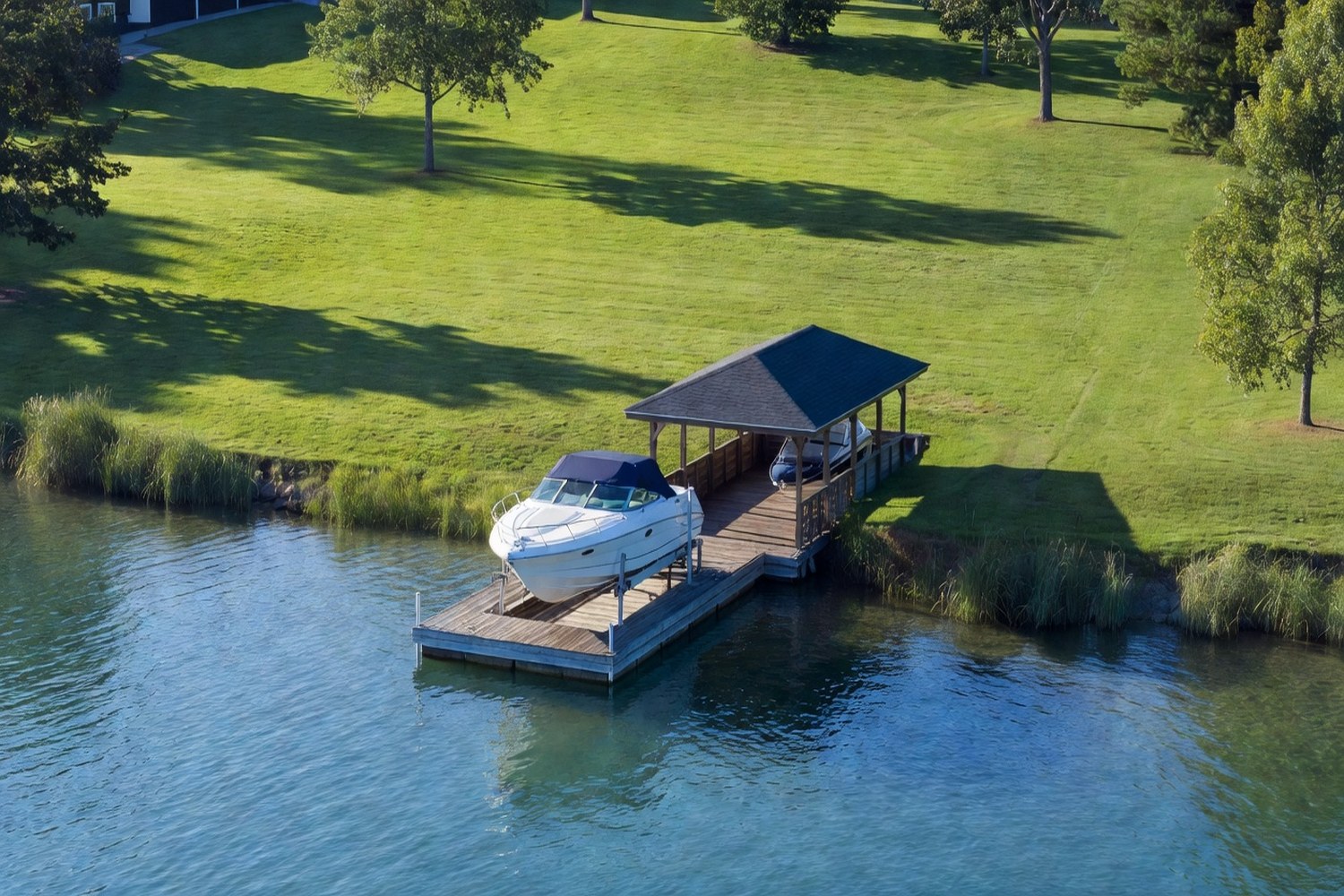
A private dock with boat lift adds 15-25% to lakefront property values — one of the strongest ROI waterfront improvements.
Permits, Regulations & Hidden Costs
This is where dock projects get complicated — and where unprepared homeowners burn months of time and thousands of dollars.
Federal permits. If your waterway is classified as “navigable waters of the United States” (most rivers, lakes connected to navigable rivers, and all coastal waters), you need a permit from the U.S. Army Corps of Engineers under Section 404 of the Clean Water Act. This is not optional. The Corps reviews your dock design for impact on navigation, wetlands, and aquatic habitat. Nationwide permits (pre-approved categories for small projects) take 30-60 days. Individual permits (for larger or environmentally sensitive projects) can take 6-12 months. Cost: $0 for nationwide permits, $100-$500 for individual permits.
State permits. Every state with navigable waterways has its own dock permitting process — often administered through the Department of Environmental Quality, Department of Natural Resources, or equivalent agency. Requirements vary enormously. Michigan requires an application to the DEQ for any structure below the ordinary high water mark. Florida requires permits through the DEP plus a submerged land lease for docks over a certain size. Timeline: 30 days to 6 months depending on state.
Local permits. Your county or municipality may have additional zoning requirements, setback rules (how far your dock must be from the property line), and size limitations. Some lake associations and HOAs have their own dock standards that go beyond government requirements.
The financing implication: Start the permit process 3-6 months before you plan to build. Only apply for your loan 4-6 weeks before the expected construction start date — you don’t want to make loan payments for months while waiting on a permit. If the permit is denied or requires a design change, you’ll be glad you didn’t already have a loan disbursed.
How to Finance Your Dock
Step 1: Start permits before financing (3-6 months ahead). Contact your state’s DNR or environmental agency, the Army Corps of Engineers (if on navigable water), and your county zoning office. Determine what’s allowed, what permits are needed, and the expected timeline. This prevents applying for a loan and then discovering you can’t build what you planned.
Step 2: Get 2-3 dock builder quotes with identical scope. Specify: dock type, length, width, decking material, number of slips, boat lift (type and capacity), electrical service, and lighting. Include permit assistance in the scope — many experienced dock builders handle the permitting process. Quotes for a 40-foot pile dock with one lift and electrical should be within 15-20% of each other.
Step 3: Add 15% for contingencies. Marine construction surprises include: harder-than-expected bottom conditions requiring longer pilings ($1,000-$3,000 extra), discovering the water is deeper or shallower than estimated, permit conditions requiring design modifications, and weather delays that increase labor costs. Finance total quote × 1.15.
Step 4: Check your local credit union, then pre-qualify at 2-3 lenders. Credit union first (dock-specific programs, best rates). Then LightStream (via Credible), SoFi, Upgrade. Compare APR, monthly payment, and total cost. Takes 20-30 minutes.
Step 5: Time the loan to construction start. Finalize the loan 4-6 weeks before the builder’s scheduled start date — not 6 months ahead while permits are pending. Most personal loans fund in 1-3 days, so you don’t need months of lead time. Pay the builder on a milestone schedule: 25% deposit, 50% at framing/piling completion, 25% at final completion and inspection.
Frequently Asked Questions
What’s the best way to finance a boat dock?
A personal loan from LightStream (6.49%+, up to $100K) or your local credit union (often 1-2% lower for dock-specific programs). For projects over $25K with home equity: a HELOC offers the lowest rate. Always check your local credit union before applying with a national lender — waterfront communities often have dedicated dock loan products.
How much does a boat dock cost?
Floating dock: $2,000-$8,000. Pipe dock: $3,000-$10,000. Permanent pile dock: $8,000-$30,000. Custom dock with covered slip: $20,000-$65,000+. Add a boat lift ($2,000-$15,000), electrical ($1,500-$4,000), and permits ($200-$2,000). Total typical project: $12,000-$35,000.
Do I need a permit to build a boat dock?
Almost always yes. Federal permits from the Army Corps of Engineers are required on navigable waters. State permits are required in virtually every state. Local zoning permits may also apply. Start the permit process 3-6 months before planned construction — don’t apply for financing until permits are in hand or nearly approved.
Can I finance a boat dock with bad credit?
Yes. Upgrade accepts 580+ credit up to $50K. Acorn Finance (partnered with many dock builders) works with various credit profiles. Expect 14-25% APR at lower tiers. A smaller floating dock ($3,000-$6,000) is a more financeable option at higher rates than a $30,000 permanent dock.
Does a boat dock increase property value?
Significantly. Lakefront homes with private docks sell for 15-25% more than comparable homes without dock access. A $20,000 dock on a $400,000 lake home can add $60,000-$100,000 in property value — one of the strongest ROI improvements for waterfront properties.
References
- Army Corps of Engineers, “Section 404 Permits,” usace.army.mil
- EPA, “Section 404 of the Clean Water Act,” epa.gov
- CFPB, “What Is a Home Equity Line of Credit?” consumerfinance.gov
Keep Reading
- Best Personal Loans: Compare Rates & Apply Online
- Best Home Improvement Loans & Financing
- Best Swimming Pool Financing & Loan Options
- Best Personal Loans for Good Credit
- Best Personal Loans for Fair Credit
Rates and terms are subject to change. This is not financial advice. All information is for educational and comparison purposes only. Dock cost estimates based on national averages as of early 2026. Permit requirements vary by state, county, and waterway. Always get multiple builder quotes and verify current lender rates before committing to financing.